

Game on! SLVB project scores HK$6.45m in new funding

Invented by Dr Leung and her team in earlier years, Sitting Light Volleyball (SLVB) has been shown to improve agility, cardiovascular endurance and upper body strength among people with disabilities, while providing an enjoyable sporting experience.

Sitting Light Volleyball provides an opportunity for people with physical challenges to leave their wheelchairs and enjoy the freedom of exercising their bodies alongside those without disabilities, while the sport also stimulates interaction among players.
Dr Carman Leung Ka-man, Associate Professor in the Department of Health and Physical Education (HPE), has been awarded HK$6.45 million under the Research Grants Council (RGC)’s Research Impact Fund (RIF) 2025/26. Out of 195 proposals submitted this year, only 13 projects were funded, representing a success rate of 6.67%. Dr Leung’s achievement in this highly competitive exercise highlights both her academic excellence and the substantial societal impact of her work.
Dr Leung’s project, entitled “Revolutionizing Adapted Physical Activity for Individuals with Physical Disabilities: Examining the Health Impact of and Promoting Sitting Light Volleyball in the Greater Bay Area”, will implement a 16 week Sitting Light Volleyball (SLVB) intervention for adults with physical disabilities in Hong Kong and the Chinese Mainland. The 42-month study will compare SLVB with seated dance and control groups, with the aim of examining the physical and psychological health effects on people with physical disabilities.

Dr Carman Leung Ka-man from HPE gives an opening remark at the Grand Finals of the Light Volleyball Competition for Older Adults held on 26 and 27 July 2024 at the Tai Po campus. She says that while ageing is an inevitable trend, she hopes that sports like LVB and SLVB can enhance the quality of life of older adults and people with physical disabilities.
The knowledge transfer project also features experiential sessions and competitions to promote SLVB, practitioner training, the development of teaching aids, and the identification of barriers and facilitators to future adoption. This is the second time that Dr Leung has secured support from the RIF, underscoring the continued relevance and impact of her research.
Studies show that the SLVB can improve agility, cardiovascular endurance and upper body strength among people with disabilities.

Comparing with traditional volleyball, light volleyball is lighter, softer and bigger. It travels more slowly in the air, allowing players extra time to react and position themselves for strikes.
Invented by Dr Leung and her team in earlier years, SLVB enables players with and without physical disabilities to participate from a sitting position on the court, similar to regular sitting volleyball. While both players of SLVB and regular sitting volleyball need to remain seated to use their hands or arms to hit the ball while playing; SLVB uses a lighter, softer and bigger ball in the game. The special design of the light volleyball make it travels more slowly in the air, allowing players extra time to react and position themselves for strikes. Dr Leung’s pilot studies have shown that the SLVB can improve agility, cardiovascular endurance and upper body strength among people with disabilities, while also providing an enjoyable and inclusive sporting experience.
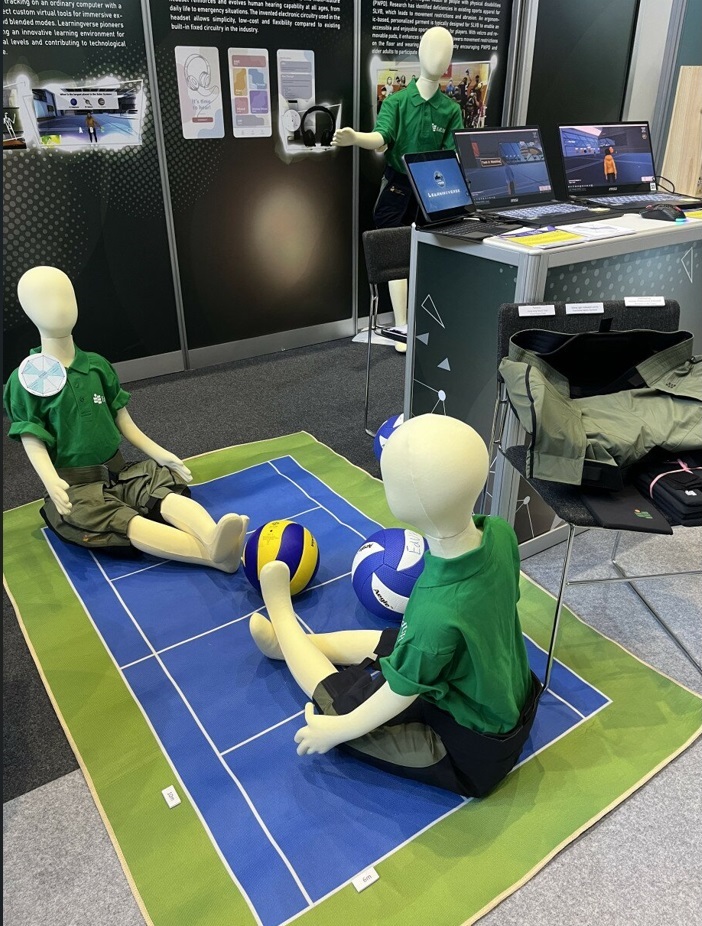
The multifunctional sports equipment developed for seated sports activities has likewise gained international recognition, winning a Bronze Medal at the 2023 International Exhibition of Inventions Geneva, as well as a Gold Medal and Special Award at the 2023 International Invention Innovation Competition in Canada (iCAN). These accolades further affirm the innovation and practical value of the project outputs.
Professor Chetwyn Chan Che-hin, Vice President (Research and Development) of EdUHK and the project’s Co-Principal Investigator, extended his warm congratulations to Dr Leung and her team and encouraged colleagues to leverage their strengths in pursuit of impactful research. “Let’s seize the opportunities to advance your scholarly trajectory. I am confident that, together, we will break new ground and propel the University toward greater success,” he said.
The RIF aims to encourage local scholars to consider the potential benefits of their research to the wider community, to promote impactful and translational projects, and to foster collaborations beyond academia, including with government departments, businesses, industry and research organisations.
